
On this page
- What a downspout has to do
- Size
- Number and position
- Where the water goes: the Clark County question
- Discharge options
- Pipes in the ground
- What are the parts of a downspout?
- Rectangular or round downspouts?
- Where should downspouts be placed on a house?
- How many downspouts does a gutter need?
- How much does it cost to add a downspout?
- What affects the price
What a downspout has to do
Collect the water from the gutter outlet, carry it down the wall without leaking or blocking, and release it where it cannot harm the house or a neighbor. Each of those steps has a way of going wrong.
Size
| Downspout | Opening | Typical use |
|---|---|---|
| 2x3 inch | 6 sq in | 5-inch gutter, small roof areas, few trees |
| 3x4 inch | 12 sq in | 6-inch gutter, large roofs, conifers overhead |
| 3 or 4 inch round | 7 to 12.5 sq in | Half-round gutter, copper work |
Under Douglas fir and cedar, the first elbow of a 2x3 downspout is where needles wedge. Moving to 3x4 is one of the cheapest ways to reduce blockages.
Number and position
- One at the low end of every run, and at both ends of a long run pitched from the middle.
- Near valleys, where flow is concentrated.
- At corners where they are least conspicuous and can serve two runs.
- Away from doors, paths and driveways where discharge would cross a walking surface and turn slick with algae in winter.
Each downspout should be strapped to the wall at intervals, with elbows riveted or screwed, and the seams facing the wall.
Where the water goes: the Clark County question
This is where local ground matters. The county's soils differ sharply over short distances.
Gravel terraces. Much of east Vancouver, Orchards and Mill Plain stands on gravelly soils laid down by Ice Age floods. The USDA describes the Sifton series, which shares its name with a neighborhood in Orchards, as having very rapid permeability, and the related Lauren series as rapid in its lower layers. Water released onto such ground a few feet from the house soaks away.
Silt and clay hills. The rolling ground toward Ridgefield, Salmon Creek and Battle Ground carries soils such as the Gee series, whose lower subsoil is moderately slow to very slow to pass water, and the Hesson series, with 35 to 50 percent clay. Here water lingers near the surface and has to be led well away, across ground that slopes from the house.
A contractor who knows the county will ask what happens to puddles in your yard before deciding where a downspout should end.
Discharge options
- Splash block or elbow at grade. Simple, and fine on free-draining soil that slopes away.
- Extension. A length of downspout or pipe carrying water several feet from the foundation.
- Buried solid pipe to daylight, emptying lower on the lot.
- Dry well, infiltration trench or rain garden. Clark County's stormwater guidance lists these designs. They rely on soil that drains.
- Rain barrel. See rain barrels and downspout rules.
- Existing underground drain. Only after testing it.
Pipes in the ground
Many houses have downspouts that vanish into a pipe at the foundation. Clark County notes that such pipes may empty at the street curb or flow on to local waterways. Old lines crack, fill with roots and silt, and back up unseen. Before a new downspout is connected, run a hose into the pipe and watch whether it takes the flow. If not, see downspout repair.
What are the parts of a downspout?
| Part | What it does |
|---|---|
| Outlet or drop | Connects the gutter floor to the downspout |
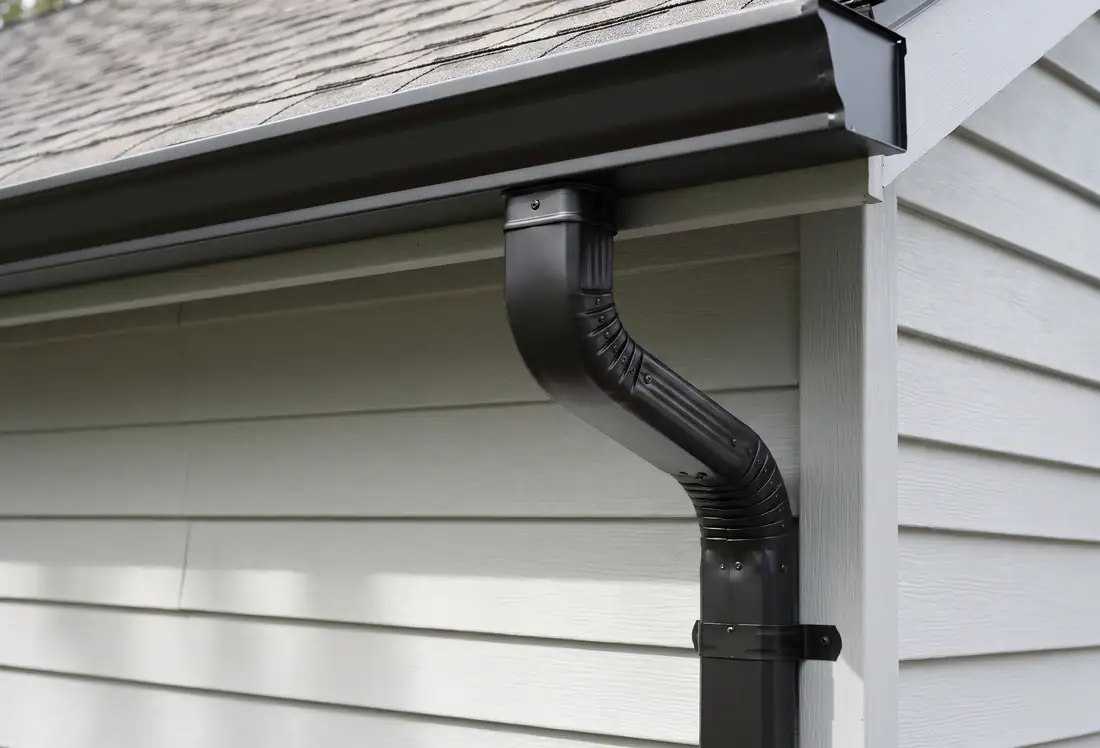
| Top elbows | Usually two, forming an offset that brings the pipe from the eave back to the wall |
| Downspout section | The straight pipe, commonly in 10-foot lengths |
| Strap, band or clip | Fastens the pipe to the wall |
| Bottom elbow or shoe | Turns the water out at the base |
| Splash block | Spreads the flow on the ground |
| Extension | Carries water farther from the house |
| Cleanout | An access opening, on downspouts feeding buried pipe |
| Diverter | Sends water to a rain barrel and passes the overflow on |
Rectangular or round downspouts?
Rectangular corrugated downspouts go with K-style gutter: 2x3 inch with 5-inch gutter, 3x4 inch with 6-inch. Round downspouts go with half-round gutter and copper work, in 3 or 4 inch. Corrugation adds stiffness; smooth round pipe passes debris slightly better and dents more easily.
Where should downspouts be placed on a house?
- At the low end of each run, and both ends of a long one
- Close to roof valleys
- At corners, where they are least visible
- Away from doors, steps and driveways
- Where the ground at the bottom slopes away
How many downspouts does a gutter need?
Enough that no run has to carry water too far or drain too much roof. A widely used rule of thumb is one downspout for every 30 to 40 feet of gutter, with a 2x3 serving roughly 600 square feet of roof and a 3x4 about twice that. A contractor should confirm against your roof area and pitch.
How much does it cost to add a downspout?
It is a small job: an outlet cut into the gutter, two elbows, a length or two of pipe, straps and an extension. Price depends on the height of the wall and the size and metal of the downspout. It is one of the cheapest ways to cure an overflowing gutter, so ask for it as a line item.
What affects the price
- Size and metal
- Height of the wall and number of elbows
- Whether new outlets must be cut into existing gutter
- Extensions, buried pipe or other discharge work
Ask for the number of downspouts and the discharge method for each to be written on the quote. The guide to downspout drainage and your foundation explains the ground-level part in full.