
On this page
- What a gutter installation includes
- How a good job is done
- Choosing size, shape and metal
- What Vancouver conditions mean for the design
- Questions to ask the contractor
- What are the parts of a gutter system?
- What size gutters does a house in Vancouver need?
- How long does it take to install gutters?
- What should a written gutter quote include?
- What it costs
- Installation services
What a gutter installation includes
A gutter system is three things working together: the trough along the eave, the downspouts that empty it, and whatever carries the water away from the house at ground level. An installation that gets the first right and ignores the other two is half a job.
On most houses the trough is seamless aluminum. The contractor brings a roll of pre-painted coil and a forming machine, runs out each length to match the eave, and cuts it on site. The only joints are at corners, end caps and outlets.
A complete installation covers:
- Taking down and hauling away the old gutters, if there are any
- Checking the fascia board and replacing sections that are soft
- Forming and hanging the new gutter with a consistent fall toward each outlet
- Fitting corners, end caps and outlets, and sealing each joint
- Hanging downspouts and directing the discharge away from the foundation
- Running water through the finished system
How a good job is done
Measuring. Each run is measured along the fascia, and the roof area draining to it is worked out. That roof area, not the length of the gutter, decides how big the gutter and downspouts need to be.
Pitch. Gutters are not hung level. They fall gently toward the outlet, commonly around a quarter inch for every ten feet. Long runs are often pitched from the middle toward a downspout at each end, so the drop stays small enough not to show.
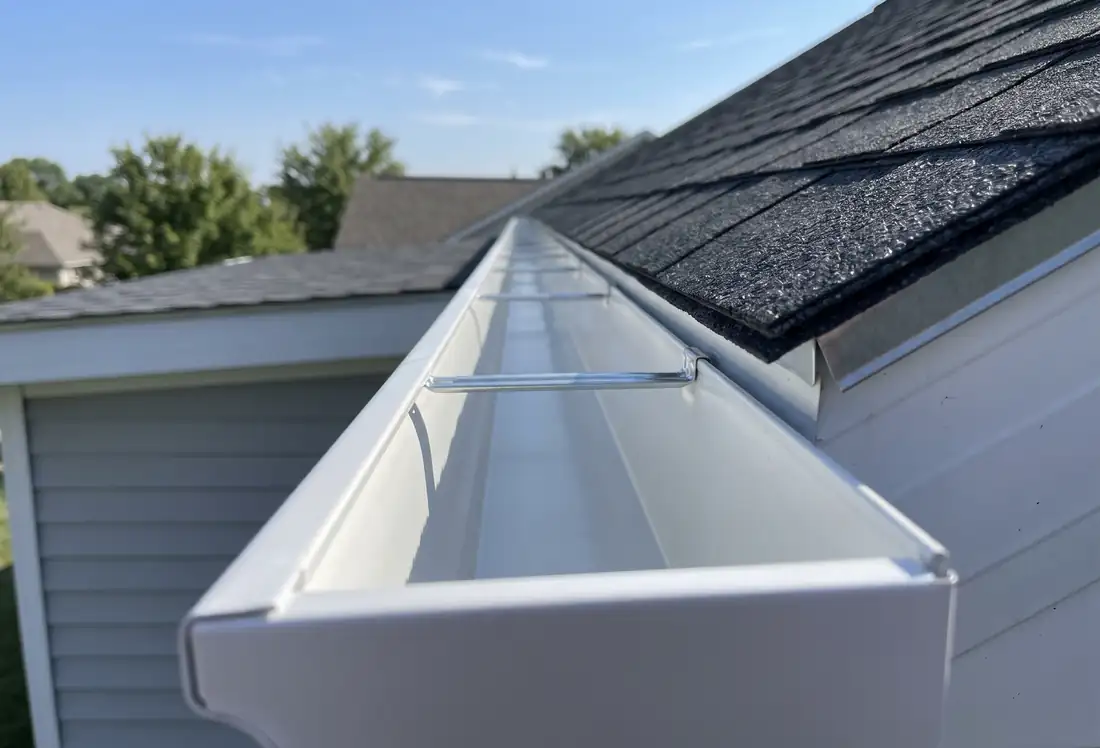
Hangers. Hidden hangers clip inside the gutter and screw through the back into the fascia. They should be close together, and into sound wood. Old-style spikes driven through the face of the gutter loosen as the wood swells and shrinks through wet winters and dry summers.
The roof edge. Water should drop off the shingles into the gutter, not run behind it. Where the shingles stop short, a strip of metal flashing under the first course bridges the gap. Missing flashing is one of the commonest reasons for a rotted fascia.
Sealing. Corners and end caps are sealed from the inside with gutter sealant on clean, dry metal.
Testing. A hose at the high end of each run shows whether the pitch is right and the joints are tight. Ask for it.
Choosing size, shape and metal
| Decision | Common choice | When to go another way |
|---|---|---|
| Size | 5-inch K-style | 6-inch for large or steep roof planes and below valleys |
| Shape | K-style | Half-round on older houses where it suits the trim |
| Metal | Aluminum | Steel for strength under trees, copper for a long-lived feature |
| Downspouts | 2x3 inch | 3x4 inch with 6-inch gutter, or where needles clog the smaller size |
The guides compare these in detail: 5-inch vs 6-inch, aluminum vs steel vs copper and seamless vs sectional.
What Vancouver conditions mean for the design
Long, steady rain. Pearson Field averages 37.47 inches of precipitation a year, and NOAA's figures show measurable precipitation on about 161 days. The gutter is wet for months at a stretch, so standing water from a poor pitch never dries. It breeds moss and rots sealant.
More rain to the north and east. Rainfall climbs toward the foothills. Battle Ground's climate table shows 52.37 inches a year, about 40 percent more than Vancouver. A design that copes in Fisher's Landing may be marginal in Yacolt.
Conifers. Douglas fir and cedar needles slide through wide screens and pack into 2x3 downspout elbows. Larger outlets and downspouts, and a plan for cleaning or guards, belong in the design, not as an afterthought.
Very different soils. East Vancouver and Orchards sit on gravelly terrace soils that the USDA describes as having very rapid permeability. The hills toward Ridgefield and Battle Ground carry silty and clay soils whose lower layers drain slowly. Where a downspout can safely empty depends on which you have. See downspout drainage and your foundation.
Questions to ask the contractor
- What size gutter and downspout are you quoting, and why that size for this roof?
- What thickness is the aluminum?
- What kind of hangers, and how far apart?
- How many downspouts, and where will each one discharge?
- Is removal of the old gutters and disposal included?
- What happens if you find rotten fascia once the old gutter is off?
- What is your L&I registration number?
- What warranty do you give on labor, and is it in writing?
What are the parts of a gutter system?
A quote makes more sense when you know the names. From the roof down:
| Part | What it is |
|---|---|
| Drip edge or gutter apron | Metal flashing under the first row of shingles that steers water into the gutter |
| Fascia | The board along the rafter ends that the gutter is fastened to |
| Gutter section or run | The trough itself, K-style or half-round |
| Hidden hanger | A bracket clipped inside the gutter and screwed through its back into the fascia |
| Spike and ferrule | The older fastener: a long nail through the gutter face and a spacer tube |
| End cap | The plate that closes the end of a run |
| Miter | An inside or outside corner where two runs meet |
| Outlet or drop | The fitting in the gutter floor that feeds the downspout |
| Elbow | An angled piece that turns the downspout toward or along the wall |
| Downspout or leader | The vertical pipe, 2x3 or 3x4 inch rectangular, or round |
| Downspout strap or band | The clip that holds the downspout to the wall |
| Splash block or extension | What receives the water at the bottom and moves it from the foundation |
What size gutters does a house in Vancouver need?
Most single-story houses here are served by 5-inch K-style gutter with 2x3 downspouts, provided there are enough downspouts. Step up to 6-inch gutter with 3x4 downspouts where one eave drains a large or steep roof plane, where a valley empties onto the run, or where conifers keep blocking smaller outlets. Size is set by the roof area feeding each downspout and by local rainfall, not by the length of the gutter.
How long does it take to install gutters?
The gutter is formed from coil at the curb, so a straightforward single-family house is commonly finished within a day of the crew arriving. Removal of old gutters, fascia carpentry, two-story access and many corners each add time. Ask the contractor for a start date, a duration and what happens if rain interrupts sealing.
What should a written gutter quote include?
- Linear feet of gutter, by run
- Profile and width: 5-inch or 6-inch K-style, or half-round
- Metal and thickness: for example .027 or .032 inch aluminum
- Color, by the supplier's name for it
- Hanger type and spacing
- Number, size and location of downspouts
- Where each downspout discharges
- Tear-off and disposal of the existing system
- How fascia or soffit repairs are priced
- Flashing at the roof edge, if needed
- Warranty terms, tax and payment schedule
What it costs
Ballpark for your roofline
$1,440 to $2,240
Arithmetic from national price ranges (Angi aluminum gutter cost guide, This Old House seamless gutter cost guide), not a local quote. The number of corners and downspouts, fascia repairs and awkward access all move it. A contractor who has measured your house gives the real figure.
The Vancouver cost guide explains each factor.