
On this page
- The shape and its history
- Where it belongs in Vancouver
- How it is hung
- How it performs
- Metals
- Repair or replace on an older house
- What are the parts of a half-round gutter system?
- Are half-round gutters better than K-style?
- How much maintenance do half-round gutters need?
- How much do half-round gutters cost?
- Which houses in Vancouver suit half-round gutters?
- What affects the price
The shape and its history
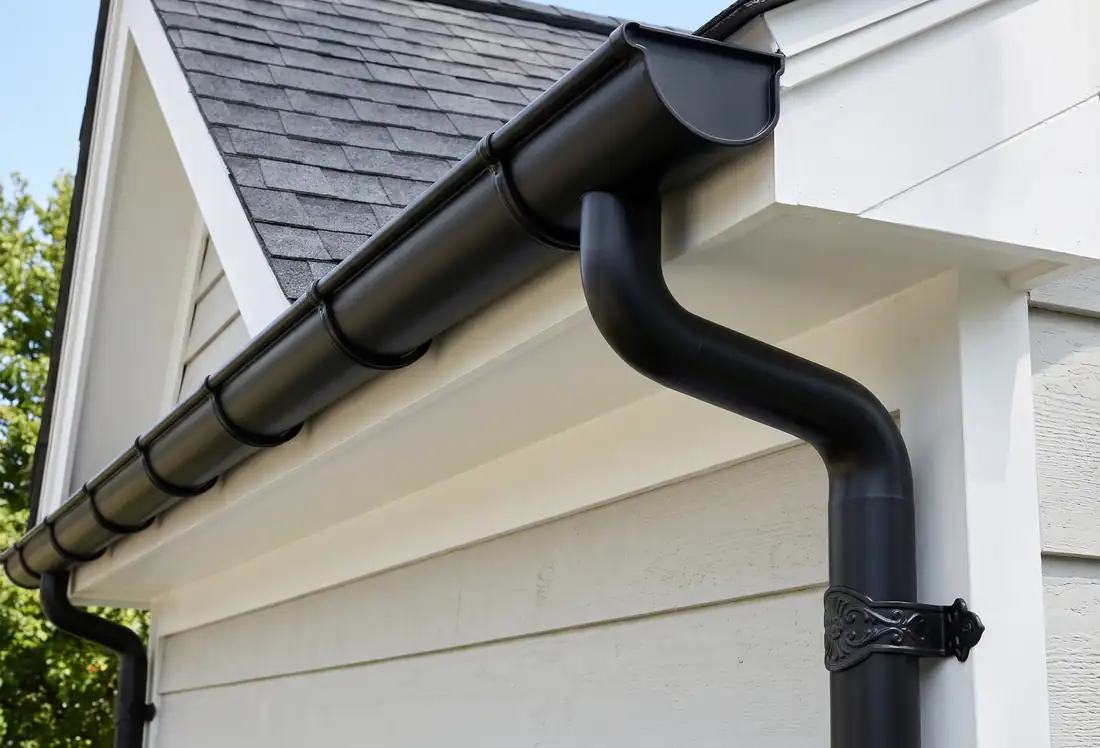
A half-round gutter is what the name says: half a tube, open at the top, usually with a rolled bead along the front edge. It hangs below the roof edge on brackets and empties into round downspouts.
Until K-style gutter became standard in the middle of the twentieth century, this was the ordinary house gutter. K-style took over because its flat back fixes straight to the fascia board and it holds more for its width. Half-round stayed in use where appearance matters.
Where it belongs in Vancouver
Clark County's heritage register describes Hough as holding the largest collection of pre-World War II housing in Vancouver, with most buildings dating from about 1890 to 1945. Neighboring Arnada is described by The Columbian as one of the city's oldest neighborhoods, with many homes built in the early 1900s.
Houses of that age were built for half-round gutter, or for gutters built into the eave. Many have shaped rafter tails or a crown molding along the roof edge where a modern house has a flat fascia. A K-style gutter screwed across that detail hides it and often sits badly. Half-round on brackets leaves it visible.
It is also a deliberate style choice on new craftsman and farmhouse designs, usually in black, bronze or copper.
How it is hung
Half-round has no flat back, so it cannot be screwed directly to a board the way K-style is.
- Fascia brackets screw to the fascia and cradle the gutter from below.
- Rafter or shank hangers fix to the rafter tails or the roof deck where there is no fascia.
- Hidden hangers made for half-round clip inside the bead.
Brackets are visible and are part of the look. They need to be closely spaced, and in line.
How it performs
- Self-cleaning shape. The curved floor has no corners for sludge to settle in. Water gathers at the bottom of the curve and moves debris along with it.
- Capacity. Less than K-style at the same width, which is why sizing up is normal.
- Round downspouts. Smooth inside, with no corrugation to snag needles, though plain round pipe dents more easily than corrugated.
- Overshoot. Because the gutter hangs out from the wall, its position under the roof edge has to be right or fast water misses it.
Metals
Half-round is made in aluminum, galvanized or painted steel, and copper. On an old house, heavy-gauge material matters more than usual, because a bracket-hung gutter relies on its own stiffness between supports.
One local caution: zinc-based roof moss treatments should not be used above copper gutters. Oregon State University Extension notes that zinc corrodes copper.
Repair or replace on an older house
Original half-round in galvanized steel eventually rusts through at the bottom of the curve. If the rust is local, a section can be replaced. If it runs the length, replace the run. Before anything new goes up, have the roof edge, rafter tails and any crown molding checked for rot. See fascia and soffit.
What are the parts of a half-round gutter system?
| Part | Purpose |
|---|---|
| Half-round section | The trough, with a rolled front bead |
| Fascia bracket | Screws to the fascia and cradles the gutter |
| Shank or rafter hanger | A strap fixed to the rafter tail or roof deck where there is no fascia |
| Hidden half-round hanger | Clips inside the bead for a cleaner look |
| Spherical or flat end cap | Closes the run |
| Outlet tube | Round drop into the downspout |
| Round downspout | Plain or corrugated, 3 or 4 inch |
| Round elbow | Turns the downspout to the wall |
| Pipe band or cast bracket | Holds the downspout, often decorative |
| Leader head | Optional collector box at the top of a downspout |
Are half-round gutters better than K-style?
Neither is better outright. Half-round drains cleanly because of its smooth curved floor, suits pre-war architecture and leaves trim visible. K-style holds more water for the same width, fixes directly to a flat fascia and costs less to install. On a 1915 bungalow the first usually wins; on a 1995 subdivision house the second does.
How much maintenance do half-round gutters need?
The same cleaning as any gutter, plus a look at the brackets. Because the gutter sits in its brackets instead of being screwed through, a bracket that has rusted or pulled loose lets the run rock. Check them when the gutter is cleaned.
How much do half-round gutters cost?
More than K-style in the same metal. The gutter itself, the brackets, the round downspouts and elbows all carry a premium, and fitting takes longer. Aluminum half-round is the least expensive version, painted or galvanized steel sits in the middle, and copper is the most. Ask for the price per foot with brackets and downspouts itemized.
Which houses in Vancouver suit half-round gutters?
- Pre-war houses in Hough, Arnada and downtown
- Craftsman bungalows with exposed rafter tails
- Early-1900s houses in downtown Camas, Washougal and Ridgefield
- New farmhouse, craftsman and cottage designs
- Any house where the gutter is meant to be seen
What affects the price
- Metal: aluminum, steel or copper
- Size, and whether it can be formed seamless
- Bracket type and how many are needed
- Round downspouts, elbows and decorative fittings
- Carpentry at the roof edge
- Height and access
Ask for the material, gauge, bracket type and spacing to be written on the quote.