
On this page
- Start with the symptom
- What a repair visit should cover
- Common repairs
- Why gutters fail in Clark County
- Repair or replace?
- What are the most common gutter problems?
- How do you know whether a gutter needs repair or replacement?
- What tools and materials does a gutter repair use?
- When is the best time to repair gutters in Vancouver?
- What affects the price
Start with the symptom
Open the line that matches what you see.
A sheet of water comes over the front lip in steady rain
Start with the outlet. Fir needles and moss mat together over the downspout opening and the trough fills behind them. If the outlet is clear, the run has probably settled and is holding water mid-span, or one downspout is being asked to drain too much roof. See gutter cleaning and 6-inch gutters.
Dripping from a corner or an end cap
On a seamless gutter the corners, end caps and outlets are the only joints, so that is where leaks show. Sealant goes brittle after years of wet winters and dry summers. The cure is to strip the joint to clean metal and reseal it, not to smear new sealant over old. See leaking gutters.
A run that dips, or has pulled off the board
Old spike-and-ferrule fasteners work loose, and a gutter full of wet debris is heavy. If a screw will not bite, the fascia behind is usually soft from years of overflow, and the wood has to be dealt with first. See sagging gutters and fascia and soffit.
Green growth in the trough or along the roof edge
Moss and seedlings mean the gutter has been holding damp debris for a long time. Clearing it is the first job; the second is finding out why it stays wet. The guide to moss, needles and gutters covers both.
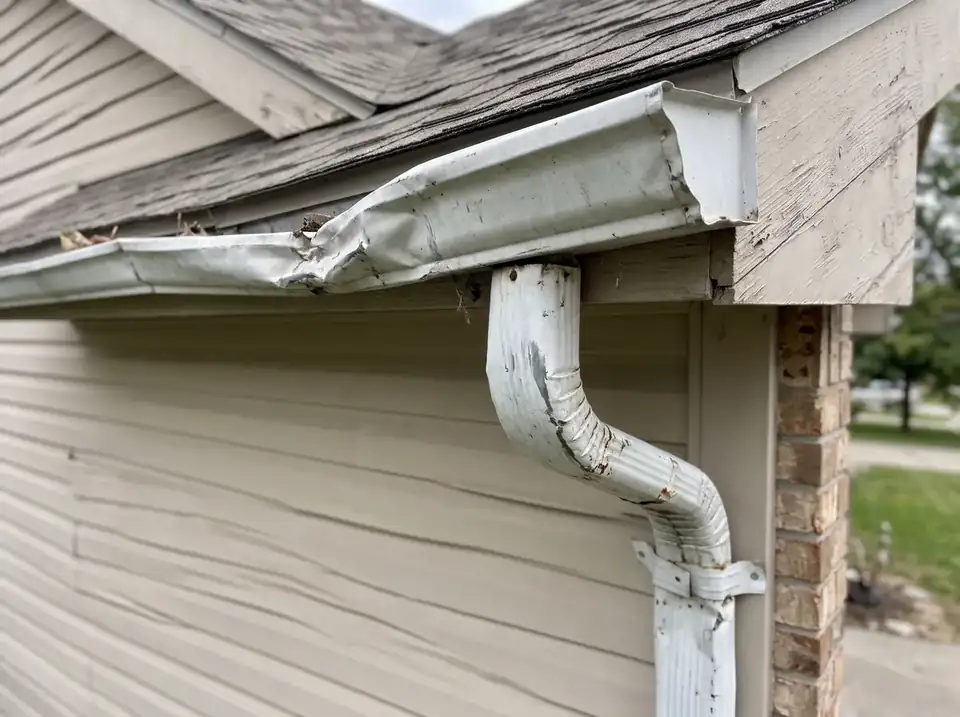
Bent, twisted or torn after a wind or ice storm
Falling limbs and ice load do the damage here far more often than hail. A crease that holds water or a section torn from its hangers needs attention before the next rain. See storm damage and ice and snow damage.
Soggy ground or a wet crawl space near a downspout
The water is being dropped too close to the house, or a buried drain line has blocked. Where it should go depends on your soil, which varies a great deal across Clark County. See downspout repair and the guide to downspout drainage.
What a repair visit should cover
A contractor who only fixes the spot you pointed at has done half the work. Gutter faults travel in groups: a blocked outlet causes standing water, standing water rots sealant and adds weight, weight pulls hangers, and a tilted gutter spills behind itself onto the fascia.
A proper repair visit includes:
- A look along every run from a ladder, not just from the lawn
- A level on any run that holds water
- A hand on the hangers to feel which are loose
- A probe of the fascia wherever a fastener has pulled
- A check of every outlet and the first elbow below it
- A hose test after the fix
Common repairs
Resealing joints. Corners, end caps and outlets are cleaned to bare metal and resealed. See leaking gutters.
Re-hanging and re-pitching. Loose spikes are replaced with hidden screw-in hangers and the run is reset to fall toward the outlet. See sagging gutters.
Downspouts. Crushed elbows, split seams, loose straps and blocked underground lines. See downspout repair.
Fascia and soffit. Rotted boards are cut out and replaced before the gutter goes back. See fascia and soffit.
Storm damage. Sections bent by limbs or torn off by wind are straightened or replaced. See storm damage.
Ice and snow. Freezing rain loads gutters with weight they were never hung for. See ice and snow damage.
Why gutters fail in Clark County
They stay wet. With measurable precipitation on roughly 161 days a year, debris in the trough turns to a wet mat that never dries between fall and spring. Sealant sits under water for months.
Needles and moss. Fir and cedar needles are small enough to pack an outlet solid. Oregon State University Extension explains that moss traps soil and debris and holds moisture. The same clumps wash off the roof into the gutter and take root there.
Trees come down. The county's damaging weather is mostly wind and ice. A December 2022 storm cut power to nearly 68,000 Clark Public Utilities customers at its peak, and the January 2024 storm brought trees down across the county. Limbs that take out power lines also land on gutters.
Old fasteners. Houses built before hidden hangers became standard have spikes through the gutter face. Decades of wet and dry cycles loosen them.
Repair or replace?
| What you see | Usually |
|---|---|
| One or two leaking corners, metal otherwise sound | Repair |
| A run that sags but is not creased | Repair: re-hang and re-pitch |
| Loose spikes all along the house | Repair: convert to hidden hangers |
| Creases, splits or holes along the length | Replace that run |
| Many old patches and mismatched sections | Replace |
| Rotten fascia behind most of a run | Replace the run once the wood is fixed |
| Gutters too small for the roof | Replace with a larger size |
The repair or replace guide goes through the decision in more detail, and the replacement page covers what a full changeout involves.
What are the most common gutter problems?
| Problem | What you see | Usual cause | Typical repair |
|---|---|---|---|
| Leak at a joint | Drip from a corner or end cap | Hardened or cracked sealant | Strip and reseal the miter, end cap or outlet |
| Overflow | Water over the front lip | Blocked outlet, lost pitch, undersized run | Clear, re-pitch, or add a downspout |
| Sag | A dip or forward tilt | Loose spikes, wide hanger spacing | Re-hang on hidden hangers |
| Detached run | Gap between gutter and fascia | Rotted fascia or pulled fasteners | Replace wood, then re-hang |
| Blocked downspout | Nothing at the bottom in rain | Needles in the top elbow, buried line clogged | Flush, replace elbow, clear or bypass the drain |
| Water behind gutter | Wet, stained fascia | Missing drip edge or gutter apron | Fit flashing under the shingles |
| Standing water | Tide line, mosquitoes, moss | Run pitched the wrong way | Reset the fall toward the outlet |
| Impact damage | Creases, flattened sections | Limbs, ladders, ice | Replace the damaged run |
How do you know whether a gutter needs repair or replacement?
Look at the metal, not the age. If the trough is straight, unpitted and the right size, its faults are at the joints and fasteners, and those are repairable. If it is creased, split, patched in many places, rusted through or has always overflowed, replacement is the sounder buy.
What tools and materials does a gutter repair use?
Knowing them helps you judge the work.
- Gutter sealant: a flexible sealant made for metal gutters, applied inside the joint on clean, dry metal
- Hidden hangers and screws: to replace spikes and ferrules
- Pop rivets or zip screws: to hold miters, end caps and downspout joints
- Patch stock: a piece of matching aluminum bedded in sealant over a hole
- Level and string line: to set the pitch
- Coil or matching section: for replacing a damaged length
- Fascia board and primer: where wood is replaced
- Drip edge or gutter apron: where water runs behind the gutter
Roofing cement, duct tape and caulk meant for windows are signs of a temporary fix.
When is the best time to repair gutters in Vancouver?
Late spring to early fall. Sealant needs dry, clean metal to bond, and July averages under half an inch of rain at Pearson Field. Faults found in winter can be made safe straight away and sealed properly on the first dry day.
What affects the price
Repairs are priced by the job, not the foot. The things that move it are the height of the roof, how much of the run has to come down, whether wood needs replacing, and whether the contractor can match your existing gutter from coil they carry. Ask for a written price before work begins and ask what is and is not included.