
On this page
- Signs that repair is no longer enough
- What a replacement involves
- Getting more than a copy of the old system
- Local points to raise
- What does gutter replacement include?
- Should gutters be replaced with the same size and style?
- What is the difference between gutter replacement and gutter installation?
- How long do gutters last?
- Cost
Signs that repair is no longer enough
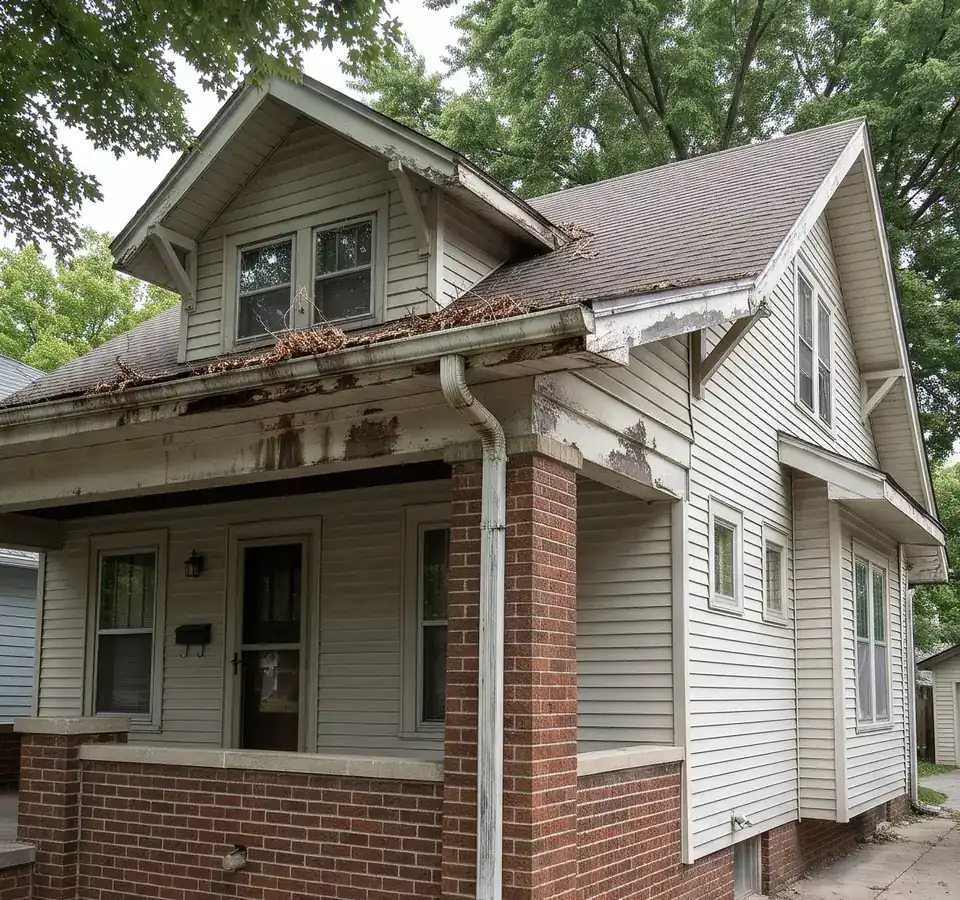
A leak or a loose hanger is a repair. Replacement becomes the better buy when faults are spread along the whole system or built into it.
- Creases and kinks. Aluminum that has been bent by a ladder, a limb or ice does not straighten cleanly. A crease holds water and debris.
- Splits and holes. Cracks along the bottom or back of the trough, or corrosion holes in old steel.
- Sectional gutters leaking at many joints. Each ten-foot joint is a place to leak, and resealing them all is a losing game.
- Patch upon patch. Several generations of sealant, tape and mismatched pieces.
- Widespread fascia rot. If the board behind most of a run has to be replaced, the gutter is coming off anyway.
- Wrong size or too few downspouts. A system that has always overflowed in ordinary rain was under-designed.
- Loose along the whole house. Spike holes that have enlarged and no longer hold.
The repair or replace guide has a fuller checklist.
What a replacement involves
1. Survey. The contractor measures every run, notes the roof area draining to each, and looks at how the existing system has performed: where it overflows, where the ground is wet, where the fascia is stained.
2. Design. Size, number and position of downspouts, and where each discharges. This is the step that separates a like-for-like swap from an improvement.
3. Tear-off. Old gutters, hangers and downspouts come down.
4. Fascia inspection. With the gutter off, the whole board is visible for the first time in years. Soft sections are cut out and replaced, then primed or wrapped. See fascia and soffit.
5. Roof edge. Flashing is checked or added so water cannot run behind the new gutter.
6. New gutters. Seamless runs are formed on site, hung on hidden hangers with a steady fall, and sealed at corners and end caps.
7. Downspouts and discharge. New downspouts are strapped to the wall and directed away from the foundation.
8. Test and clean-up. Water is run through each section, and the old material is removed.
Getting more than a copy of the old system
Ask the contractor what they would change. Common upgrades:
- Larger gutters on the runs that take the most water. See 6-inch gutters.
- An extra downspout on a long run, so no gutter carries water more than it has to.
- 3x4 downspouts where needles block the smaller size.
- Hidden hangers in place of spikes.
- Guards, fitted while everything is new and clean. See gutter guards.
- Better discharge: extensions, splash blocks or a connection to a working drain, in place of a downspout that empties at the foundation.
Local points to raise
Wartime and mid-century houses. Vancouver grew fast during the Second World War, when the National Park Service records that eight housing projects were built for shipyard workers. Houses and additions from the 1940s to the 1960s often have narrow fascia, short eaves and gutters added later. They need care with hanger fixing and roof-edge flashing.
Older neighborhoods. In Hough, where Clark County's register notes most buildings date from about 1890 to 1945, replacement is as much about matching the house as moving water. Half-round gutters may suit better than K-style.
Fast-growing suburbs. Ridgefield more than doubled in population between 2010 and 2020. Houses from the first building booms in Salmon Creek, Orchards and Cascade Park are now at the age where original builder-grade gutters and spikes give out together.
Buried drains. If downspouts drop into pipes in the ground, have them tested before new downspouts are connected. Clark County's downspout guidance explains where such pipes can lead.
What does gutter replacement include?
A full replacement, sometimes called a tear-off and reinstall, covers:
- Removal of existing gutters, hangers, spikes, downspouts and elbows
- Inspection of fascia, soffit and the roof edge
- Carpentry where wood is soft
- Drip edge or gutter apron where it is missing
- New seamless gutter, formed to length
- New hidden hangers
- New miters, end caps and outlets, sealed
- New downspouts, elbows and straps
- Discharge at the bottom: splash blocks, extensions or connection to a tested drain
- A water test, clean-up and disposal
Should gutters be replaced with the same size and style?
Not automatically. Replacement is the one moment when everything can be corrected at no extra labor: a run that overflows can go to 6-inch, a long eave can gain a second downspout, 2x3 downspouts can become 3x4, and spikes become hidden hangers. Tell the contractor where the old system failed.
What is the difference between gutter replacement and gutter installation?
Installation is fitting gutters where there are none: a new house, an addition, a garage. Replacement adds removal of the old system and the chance, or the need, to repair what it was fixed to. The new material and the method of hanging it are the same.
How long do gutters last?
| Material | What ends its life |
|---|---|
| Aluminum | Physical damage, pitting under debris, poor installation; the metal does not rust |
| Galvanized steel | Rust once the zinc coating wears through, soonest where water stands |
| Copper | Very little; usually outlasts the roof when joints are soldered |
| Vinyl | Brittleness from sun and age, sagging between brackets |
Sealant and fasteners wear out before the metal does. A gutter that is kept clean and re-hung when needed lasts far longer than one that is ignored.
Cost
Replacement is priced like installation, by the foot, plus removal of the old system and any carpentry.
Ballpark for your roofline
$1,440 to $2,240
Arithmetic from national price ranges (Angi aluminum gutter cost guide, This Old House seamless gutter cost guide), not a local quote. The number of corners and downspouts, fascia repairs and awkward access all move it. A contractor who has measured your house gives the real figure.
See the cost guide for what moves the figure.