
On this page
- What seamless means
- Where a seamless system can still leak
- What to specify
- Why it suits this climate
- When seamless is not the answer
- How are seamless gutters made?
- What is the difference between K-style and half-round seamless gutter?
- Where are the joints on a seamless gutter?
- How much do seamless gutters cost in Vancouver, WA?
- What should I ask a seamless gutter contractor?
- What affects the price
What seamless means
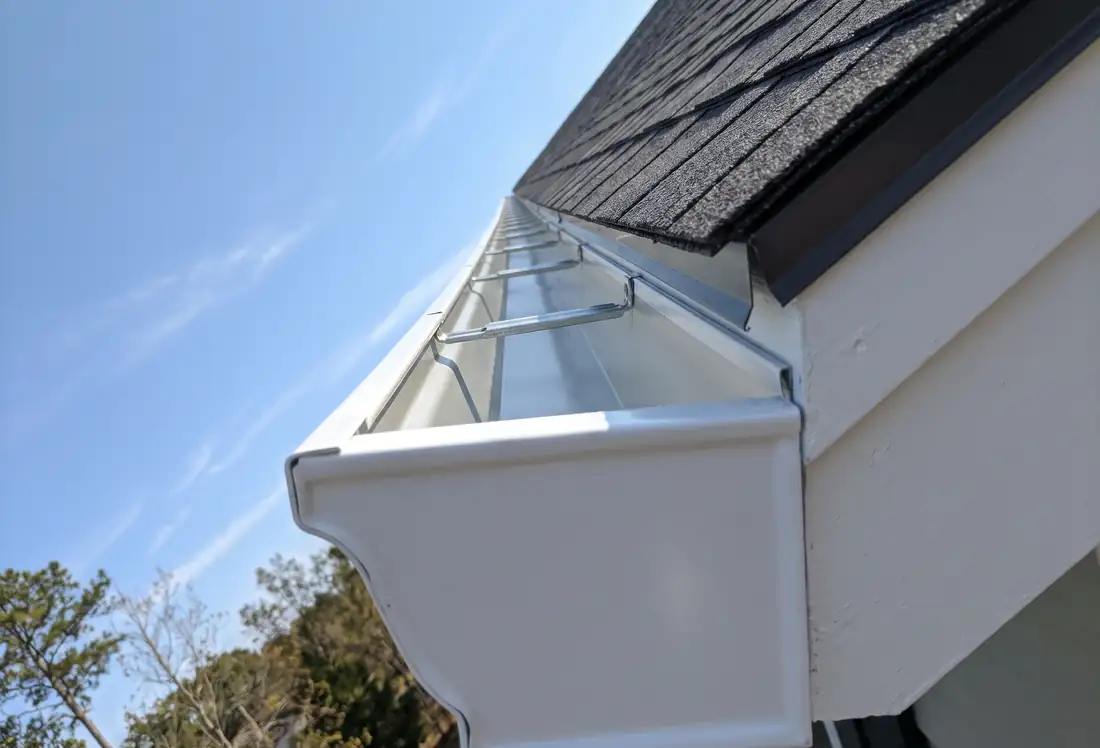
A seamless gutter is made on site. The contractor arrives with a coil of flat, pre-painted metal and a roll-forming machine in the back of a truck or trailer. The coil is fed through the machine, which bends it into a gutter profile and pushes it out as one piece. It is cut when it reaches the measured length of the eave.
The older alternative is sectional gutter: ten-foot lengths joined with connectors and sealant. Every one of those joints is a place for water to find its way out, and in a climate where gutters stay wet from fall to spring, sealant under standing water does not last.
Where a seamless system can still leak
- Inside and outside corners (miters). Two lengths meet at an angle and are sealed.
- End caps. Crimped on and sealed.
- Outlets. The hole where the downspout drops out.
- Behind the gutter. Not a gutter leak at all: water running off the roof edge and down the fascia because the flashing is missing or short.
A careful installer cleans and dries each joint before sealing it and seals from the inside. If you are getting quotes, ask how corners are made. Hand-cut miters and box miters both work when sealed well; strip miters, a narrow cover over a butt joint, rely most on the sealant.
What to specify
Profile and size. K-style in 5-inch is the default for houses. Six-inch carries more and suits bigger roofs.
Metal thickness. Aluminum coil for gutters is commonly sold in .027 and .032 inch. The thicker metal resists ladder dents and holds its shape on long runs. Ask which is being quoted; the difference is not visible once it is on the house.
Hangers. Hidden hangers with screws, not spikes, at close spacing.
Color. Coil comes painted. Choose from the supplier's chart in daylight against your trim.
Downspouts. Size, number and where each empties. See downspouts.
Why it suits this climate
Vancouver's weather station records measurable precipitation on about 161 days a year. A joint in the middle of a run sits in the stream for all of them. Removing those joints removes the commonest failure.
The second reason is debris. Needles catch on the lip of every connector in a sectional gutter and start a dam. A seamless trough has a smooth floor from end to end, so needles keep moving toward the outlet.
When seamless is not the answer
- A short repair. Replacing six feet of damaged gutter does not justify bringing the machine. A contractor may splice in a formed offcut.
- A profile that has to be matched. Old half-round or custom profiles on houses in Hough or Arnada may need sectional or specially formed pieces. See half-round gutters.
- Sheds and outbuildings where a home-center sectional gutter is good enough.
The guide seamless vs sectional compares the two in more detail.
How are seamless gutters made?
On site, with a portable roll-forming machine, often called a gutter machine.
- A coil of flat painted metal, around a foot wide for 5-inch gutter, is loaded on a spool.
- The coil feeds through a series of rollers that fold it step by step into the K-style profile.
- The formed gutter runs out onto stands until it reaches the measured length.
- A built-in shear or a saw cuts it square.
- Outlets are punched, end caps crimped on, and the run is carried to the eave.
Separate machines form 5-inch, 6-inch and half-round profiles, and some combination machines do two sizes.
What is the difference between K-style and half-round seamless gutter?
| K-style | Half-round | |
|---|---|---|
| Shape | Flat back and bottom, molded front | Semicircle with a beaded edge |
| Fixing | Hidden hangers to the fascia | Brackets or rafter hangers |
| Capacity for its width | Higher | Lower; usually sized up |
| Downspouts | Rectangular, 2x3 or 3x4 | Round, 3 or 4 inch |
| Look | Modern standard | Traditional |
Where are the joints on a seamless gutter?
Only where one piece ends: inside miters, outside miters, end caps and outlets. Three ways of making a corner are common. A strip miter is a narrow cover over two square-cut ends. A box miter is a pre-formed corner piece the runs slide into. A hand-cut miter has the two runs cut at an angle and joined directly, with the fewest seams. All are riveted and sealed inside.
How much do seamless gutters cost in Vancouver, WA?
National price guides put installed 5-inch seamless aluminum at about $9 to $14 a linear foot and 6-inch at $11 to $17. A house with 160 feet of gutter therefore works out at roughly $1,440 to $2,240 in 5-inch. These are national ranges, not local quotes; a Clark County contractor who has measured the house gives the actual price.
What should I ask a seamless gutter contractor?
- Is the gutter formed on site from coil, one piece per run?
- Is the aluminum .027 or .032 inch?
- Are corners strip, box or hand-cut miters, and how are they sealed?
- What hangers are used and at what spacing?
- How many downspouts, of what size, and where do they discharge?
- Is tear-off, disposal and any fascia repair included?
- What is your Washington L&I contractor registration number?
What affects the price
Seamless gutter is priced by the linear foot installed. Published national guides put 5-inch seamless aluminum at roughly $9 to $14 a foot; those are national figures, not local quotes. What moves a real quote:
- Total length, and how many separate runs
- Number of corners, each one cut and sealed by hand
- Number of downspouts
- Height: two-story work costs more
- Metal thickness and color
- Removal of old gutters and any fascia repair
Ballpark for your roofline
$1,440 to $2,240
Arithmetic from national price ranges (Angi aluminum gutter cost guide, This Old House seamless gutter cost guide), not a local quote. The number of corners and downspouts, fascia repairs and awkward access all move it. A contractor who has measured your house gives the real figure.